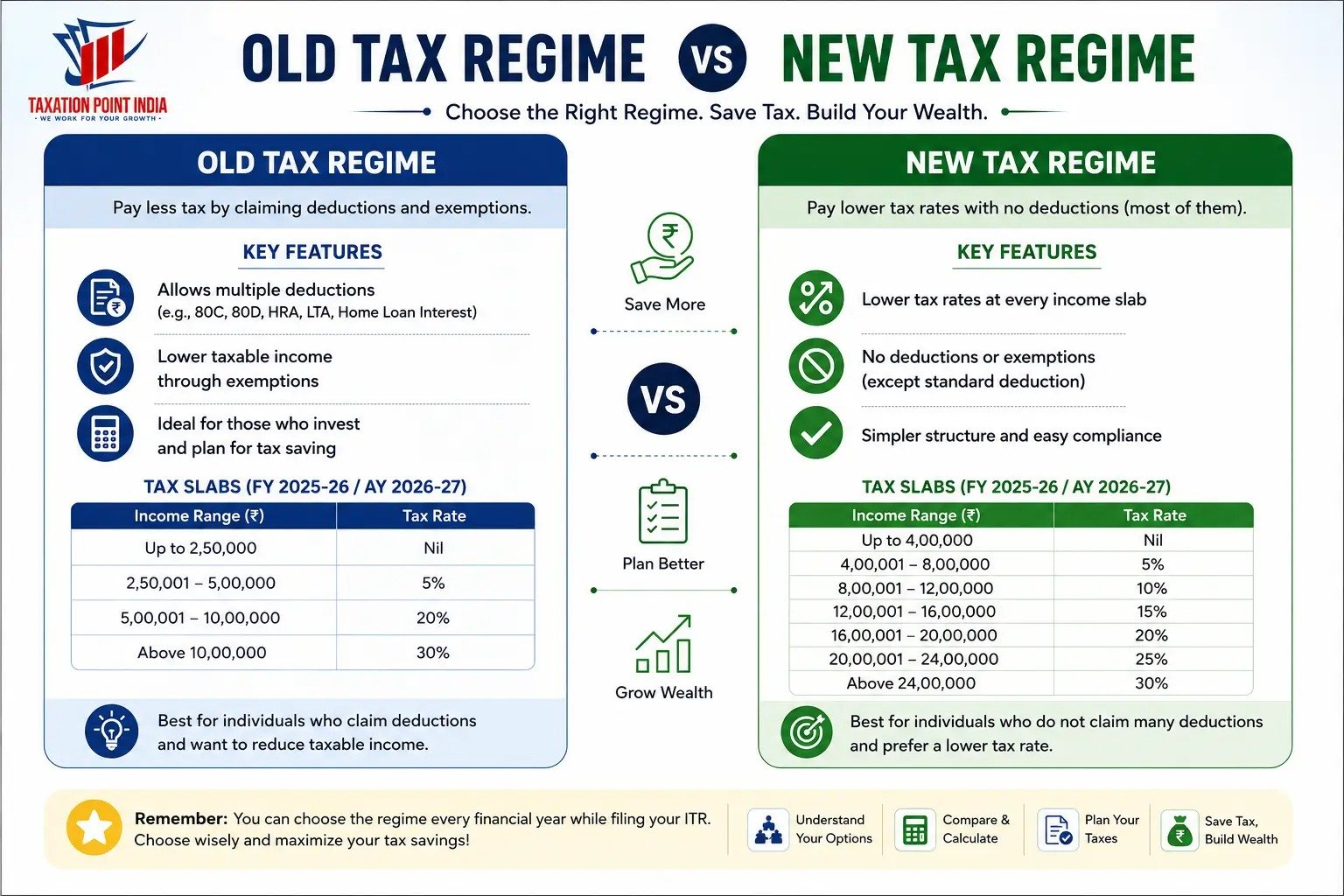
Before filing your Income Tax Return (ITR), it is important to choose the tax regime that works best for you. The Old Tax Regime lets you claim tax-saving deductions and exemptions like Section 80C, 80D, HRA, and home loan benefits. It is a good option if you invest in tax-saving schemes or have eligible expenses.
Under the New Tax Regime, taxpayers can benefit from lower tax rates, but most tax-saving deductions and exemptions cannot be claimed. It is ideal for people who prefer a straightforward tax system with fewer calculations.
Compare both options based on your income and savings before filing your ITR. Choosing the right tax regime can help you save more tax. If you need expert guidance, Taxation Point India is here to help you file your ITR quickly, accurately, and without any hassle.
Know about the New Tax Regime: Tax Slab & its Benefits
The New Tax Regime is designed to make income tax filing more straightforward. It offers lower tax rates compared to the old regime but does not allow most tax deductions and exemptions, such as Section 80C, HRA, and many others. This option is suitable for taxpayers who do not make significant tax-saving investments or prefer a simple tax structure. Before choosing the new regime, compare it with the old regime to see which one results in a lower tax liability based on your income and financial situation.
New Tax Regime Tax Slabs (FY 2025–26 / AY 2026–27)
The New Tax Regime uses a slab-based tax system, where different portions of your annual income are taxed at different rates.
If your annual income is up to ₹4,00,000, no tax is payable. Income between ₹4,00,001 and ₹8,00,000 is taxed at 5%, while income from ₹8,00,001 to ₹12,00,000 is taxed at 10%. The tax rate is 15% for income between ₹12,00,001 and ₹16,00,000, 20% for income between ₹16,00,001 and ₹20,00,000, and 25% for income between ₹20,00,001 and ₹24,00,000. Any annual income above ₹24,00,000 is taxed at 30%.
These tax slabs are applicable for Financial Year 2025–26 (Assessment Year 2026–27).
Benefits of the New Tax Regime
• Offers lower tax rates for eligible taxpayers.
• Makes income tax calculation simple and easy to understand.
• No need to invest in tax-saving schemes only to reduce tax liability.
• Suitable for individuals who do not claim many deductions or exemptions.
• Reduces the need to maintain documents for multiple tax-saving investments.
• Makes the Income Tax Return (ITR) filing process faster and more convenient.
• Ideal for taxpayers who prefer a straightforward and hassle-free tax system.
• Saves time by reducing paperwork and compliance requirements.
Know about the Old Tax Regime: Tax Slab & its Benefits
The old tax regime is suitable for taxpayers who want to claim tax benefits on eligible investments, insurance premiums, home loans, and other qualifying expenses. Claim eligible tax deductions under Section 80C, Section 80D, HRA, home loan interest, and other applicable tax-saving provisions. This regime is suitable for individuals who invest in tax-saving schemes or have eligible expenses that qualify for deductions. Before filing your Income Tax Return (ITR), compare both tax regimes to find out which one helps you save more tax.
Old Tax Regime Tax Slabs (FY 2025–26 / AY 2026–27)
Under the Old Tax Regime, tax is calculated according to your annual income using different tax rates.
If your annual income is up to ₹2,50,000, no tax is payable. Income between ₹2,50,001 and ₹5,00,000 is taxed at 5%, while income from ₹5,00,001 to ₹10,00,000 is taxed at 20%. Any annual income above ₹10,00,000 is taxed at 30%.
These tax slabs are applicable for Financial Year 2025–26 (Assessment Year 2026–27).
Benefits of the Old Tax Regime
• Allows you to claim deductions under Section 80C, Section 80D, and other eligible sections.
• Provides tax benefits on House Rent Allowance (HRA) and other eligible exemptions.
• Save more tax by claiming deductions on eligible home loan interest.
• Suitable for taxpayers who regularly invest in tax-saving instruments.
• Can help lower your overall tax liability when you claim eligible deductions and exemptions.
• A good option for salaried individuals with multiple tax-saving investments.
• Helps taxpayers maximise savings through various tax benefits available under the Income Tax Act.
• Ideal for individuals who want to reduce their taxable income by making eligible investments and expenses.
Which Tax Regime suitable? Understand with an Example
Abhinav is a salaried employee with an annual income of ₹18 lakh. Every year, he invests ₹1.5 lakh under Section 80C, pays ₹30,000 as health insurance premium under Section 80D, receives House Rent Allowance (HRA) from his employer, and pays interest on his home loan, which qualifies for a tax deduction.
When Abhinav compared both tax regimes, he found that the Old Tax Regime was more beneficial because it allowed him to claim deductions and exemptions that significantly reduced his taxable income. Although the New Tax Regime offers lower tax rates, it does not allow most of these tax benefits.
For Abhinav, the Old Tax Regime is the better choice because his eligible deductions and exemptions help him save more tax than the lower tax rates available under the New Tax Regime.
Conclusion: The best tax regime depends on your income, deductions, and financial situation. It is always advisable to compare your tax liability under both regimes before filing your ITR.
Don't be confused! Always take an expert’s assistance
Choosing the right tax regime can be confusing, especially when you have multiple sources of income, investments, or deductions. A wrong choice may result in paying more tax than necessary.
At Taxation Point India, our tax experts carefully compare both the Old Tax Regime and the New Tax Regime based on your income, deductions, and financial goals. We help you select the most suitable option, calculate your tax liability accurately, and file your Income Tax Return (ITR) without any hassle.
Whether you are a salaried employee, freelancer, business owner, or professional, our team provides reliable guidance and complete support throughout the ITR filing process.
Get in touch with Taxation Point India today and let our experts help you save more tax while ensuring accurate and timely ITR filing.