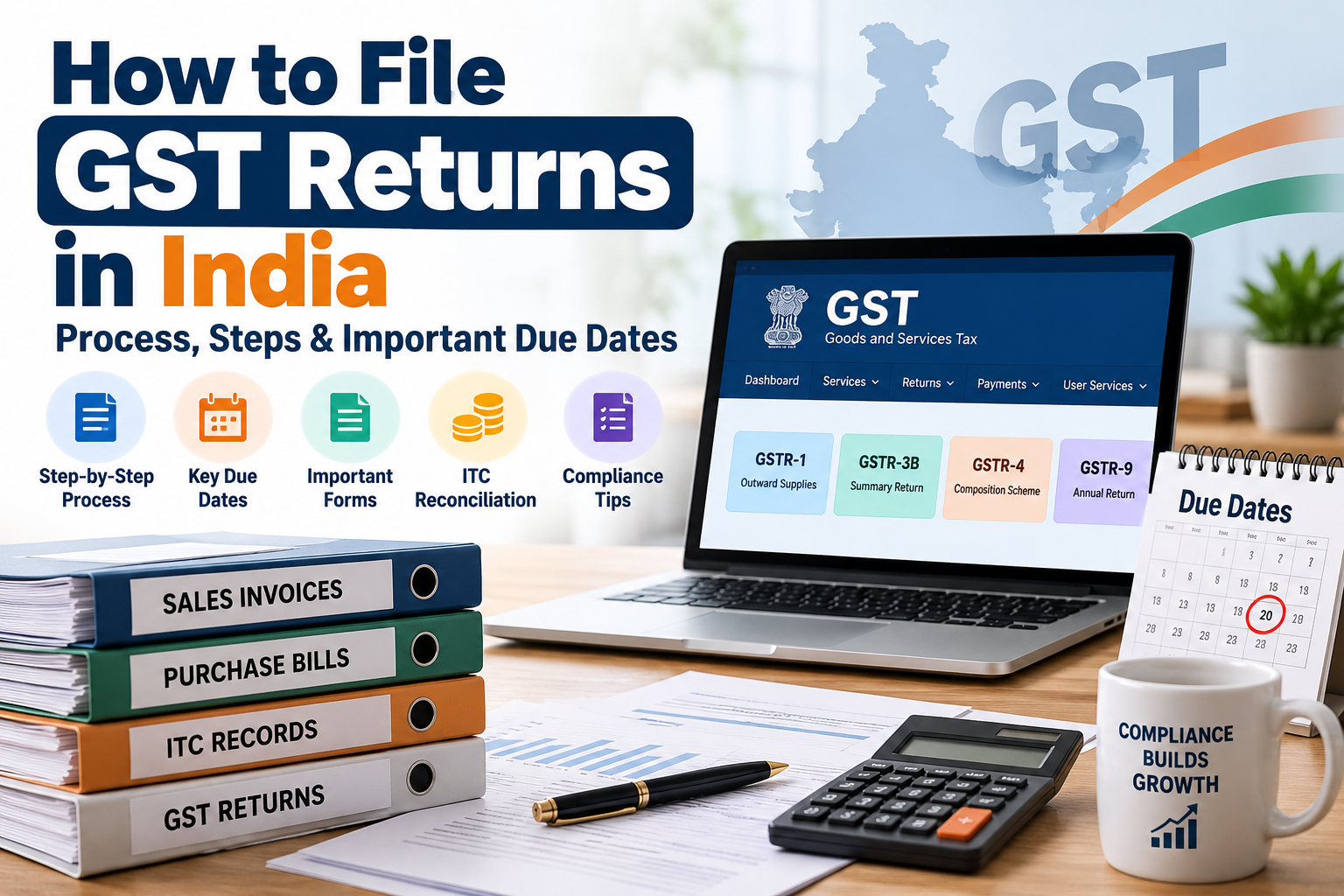
For businesses registered under GST, filing GST returns is an important part of regular tax compliance. GST return filing involves reporting relevant business transactions, tax liability, eligible Input Tax Credit (ITC), and other required information through the GST portal.
Whether you run a small business, provide professional services, trade in goods, or operate a growing company, filing GST returns on time helps maintain compliance and reduces the risk of late fees, interest, and other issues.
What Is GST Return Filing?
GST return filing is the process of reporting a business’s sales, purchases, tax liability, and other required details on the Goods and Services Tax Portal. Depending on the type of taxpayer and applicable GST provisions, the information may include:
• Sales and outward supplies
• Purchases and Inward supplies (ITC Details)
• GST collected from customers
• GST payable
• Tax already paid
• Credit notes and debit notes
• Other transaction-related information required as per the applicable GST return.
What Are the Main GST Returns?
Different taxpayers are required to file different types of GST returns. Some commonly filed GST returns are:
GSTR-1
GSTR-1 is used by registered taxpayers to report details of outward supplies, including applicable invoice and sales information.
GSTR-3B
GSTR-3B is a summary return where eligible taxpayers declare their GST liability, claim eligible Input Tax Credit (ITC), and report the tax amount payable.
GSTR-4
GSTR-4 applies to taxpayers covered under the composition scheme, subject to the applicable rules and filing requirements.
GSTR-9
GSTR-9 is an annual return applicable to certain taxpayers, subject to applicable conditions and exemptions. The GST return a business needs to file depends on factors such as its registration type, turnover, business activities, and the applicable GST rules.
Documents Required for GST Return Filing
Before filing GST returns, businesses should keep their relevant records and supporting documents ready. These may include:
• Sales invoices
• Purchase invoices
• Credit notes and debit notes
• GST payment details
• Bank and transaction records, where relevant
• Previous GST return details
• Input Tax Credit details
• GSTR-2B data for ITC reconciliation
• E-way bill details, wherever applicable
• Other records required for the applicable GST return
Maintaining updated books of accounts and properly organised invoices can make the GST return filing and reconciliation process easier.
How to File GST Returns Online?
A general GST return filing process is as follows:
1. Collect Business Records
Keep sales invoices, purchase bills, credit notes, debit notes, payment details and other relevant records ready.
2. Verify Sales and Purchase Transactions
Review the transactions recorded in your books and check whether invoice numbers, dates, GSTINs, taxable values and GST amounts are correctly recorded.
3. Reconcile Input Tax Credit
Compare eligible ITC recorded in your books with the relevant information available through GSTR-2B and identify differences that may require clarification or correction.
4. Login to the GST Portal
Access the official GST portal using your GST login credentials.
5. Select the Applicable Return
Select the GST return applicable to your business, such as GSTR-1 or GSTR-3B.
6. Enter or Upload the Required Details
Enter the required sales, tax, ITC, and other relevant details in the appropriate sections of the GST return.
7. Calculate Tax Liability
Review the output tax liability and eligible ITC and determine the amount of GST payable, wherever applicable.
8. Pay GST, If Applicable
If tax is payable, make the required payment through the available GST payment options.
9. Review and File the Return
Carefully verify all the information before submitting the return. Complete the applicable verification process, such as EVC or DSC, wherever required.
10. Save the Filing Details
After successful filing, save the acknowledgement, ARN and other relevant records for future reference.
What Are the GST Return Due Dates?
GST return due dates depend on the type of return, taxpayer category, filing frequency and applicable GST scheme.
For many regular taxpayers:
• GSTR-1: Due by the 11th of the next month for monthly filers.
• GSTR-3B: Due by the 20th of the next month for monthly filers.
Taxpayers covered under quarterly filing schemes may have different due dates. Businesses should check the applicable due date on the GST portal and consider the latest government notifications or extensions.
Important: GST due dates may vary depending on the taxpayer and filing period and may also be extended by government notification.
What Is GSTR-2B and its importance?
• GSTR-2B is useful for reconciling Input Tax Credit (ITC). Businesses can match the ITC shown in GSTR-2B with their purchase invoices and accounting records before claiming eligible ITC in the relevant GST return.
• Regular reconciliation can help businesses find discrepancies such as:
• Missing invoices
• Incorrect GSTIN
• Mismatch in taxable value or GST amount
• Invoices missing from the relevant records or data
• Duplicate entries
• Other reconciliation differences
• Businesses should claim ITC only after considering the applicable GST provisions and eligibility conditions.
What Happens If GST Returns Are Filed Late?
Filing GST returns after the due date may attract applicable late fees and, in certain cases, interest on the delayed payment of tax.
Delayed filing can also affect regular compliance and may create difficulties in maintaining accurate GST records and managing Input Tax Credit.
Businesses should therefore maintain their accounts regularly and avoid waiting until the last date to prepare and file their GST returns.
Is GST Return Filing Required When There Are No Transactions?
Depending on the taxpayer and applicable return, a Nil Return may still be required even when there are no sales or purchases during the relevant tax period. Taxpayers should check their applicable filing requirements.
Can GST Returns Be Revised?
GST return correction and amendment depend on the type of return, the nature of the error and the applicable GST provisions. Businesses should carefully review their return before filing to minimise errors. Where an error is identified after filing, the appropriate correction or amendment mechanism should be considered based on the applicable GST rules.
Common Mistakes to Avoid While Filing GST Returns
Common Mistakes to Avoid While Filing GST Returns
• Reporting incorrect invoice details
• Entering an incorrect GSTIN
• Claiming ineligible ITC
• Not reconciling ITC with GSTR-2B
• Missing credit notes or debit notes
• Reporting incorrect taxable values
• Ignoring differences between books and GST records
• Filing the return after the applicable due date
• Not maintaining supporting documents and records
Proper reconciliation and review before filing can help reduce the risk of errors.
Why Choose Taxation Point India for GST Return Filing?
GST return filing can become complicated when a business has multiple sales invoices, purchase transactions, Input Tax Credit, credit notes, debit notes and regular compliance requirements.
Taxation Point India provides GST and taxation support to businesses across India. Our GST return filing support can include:
• GST return preparation
• GSTR-1 filing support
• GSTR-3B filing support
• ITC reconciliation
• GSTR-2B reconciliation
• GST liability calculation
• GST compliance support
• GST registration and related services
Our team helps businesses maintain their GST compliance in a systematic manner so that business owners can focus on their day-to-day operations.
Conclusion
Regular GST return filing is an important responsibility for registered businesses. Maintaining accurate records, reconciling Input Tax Credit, reviewing GST liability and filing the applicable return within the prescribed time can help businesses maintain proper GST compliance. If you need assistance with GST return filing, GST registration, ITC reconciliation or other GST and taxation services, Taxation Point India can help you manage your compliance requirements efficiently.
Visit: https://taxationpointindia.com/